 en
 AZE
 RUS

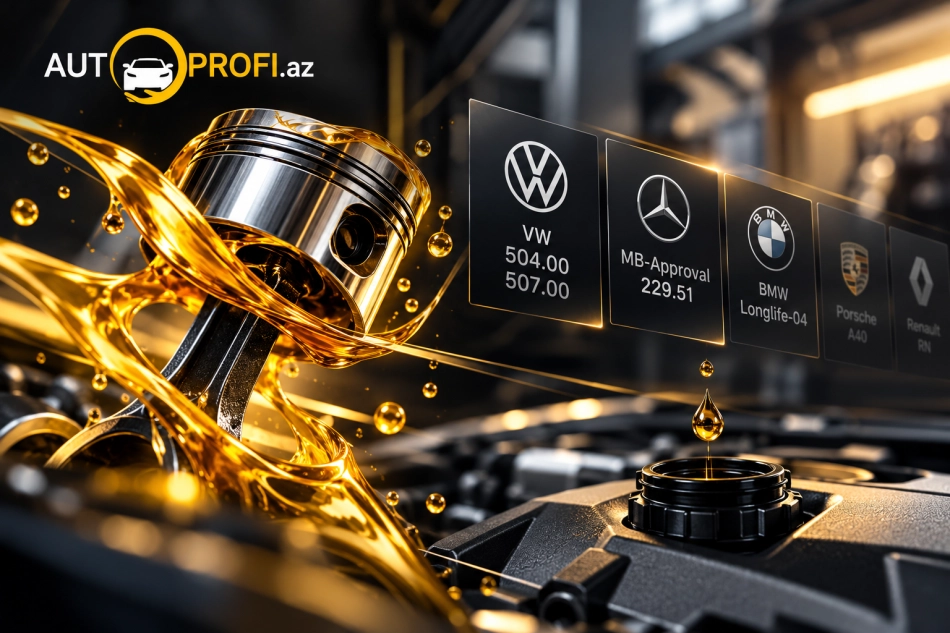
When choosing engine oil, do you pay attention only to viscosity grades such as 5W-30 or 5W-40? What do specifications such as VW 504.00/507.00, MB-Approval 229.51 and BMW Longlife-04 actually mean?
These codes are more than technical markings on an oil container. They identify specific performance requirements established by vehicle manufacturers and help determine whether an engine oil is suitable for a particular application.
Choosing the wrong oil can affect engine protection, oil service intervals and the performance of emission-control systems. Understanding manufacturer oil approvals is therefore an essential part of proper vehicle maintenance.
In this guide, we explain what OEM oil approvals are, how VW 504.00/507.00 and MB-Approval 229.51 differ, and how to select the right engine oil for your vehicle.
1. What Are Automotive Manufacturer Oil Approvals?
OEM Approval refers to an approval granted by an original equipment manufacturer (OEM) when a lubricant meets the manufacturer`s specified technical requirements and approval criteria.
Manufacturers such as Volkswagen, Mercedes-Benz and BMW establish their own requirements based on engine design, operating temperatures, lubrication systems and emission-control technology.
Depending on the specification, these requirements may address:
Engine wear protection.
Oil stability at high temperatures.
Oxidation resistance and deposit control.
Fuel economy performance.
Compatibility with diesel particulate filters (DPFs) and other emission-control systems.
Performance under specific operating conditions.
Because engines differ in design and operating requirements, one engine oil cannot automatically be considered suitable for every vehicle.
What Is the Difference Between OEM Approvals, API and ACEA?
API and ACEA classify engine oils according to defined performance requirements and technical characteristics. OEM approvals, on the other hand, address the additional requirements established by individual vehicle manufacturers.
For example, an oil that meets ACEA C3 requirements does not automatically have an official Mercedes-Benz MB-Approval 229.51 or Volkswagen VW 504.00/507.00 approval.
The key rule: If your vehicle manufacturer`s manual requires a specific OEM approval, do not select engine oil based on viscosity or general API/ACEA classifications alone.
2. What Does VW 504.00/507.00 Mean?
VW 504.00 and VW 507.00 are Volkswagen Group engine oil specifications designed for particular petrol and diesel engine applications.
They are associated with certain engines requiring defined performance characteristics, including applications where extended service intervals and compatibility with emission-control systems are important.
VW 504.00: Specification for Petrol Engines
VW 504.00 is a specification for certain petrol engines used in Volkswagen Group vehicles, including selected Volkswagen, Audi, Škoda and SEAT models.
However, the vehicle brand and fuel type alone do not determine the correct specification. The engine version, model year and manufacturer`s service requirements must also be considered.
VW 507.00: Specification for Diesel Engines
VW 507.00 is intended for certain diesel engine applications. It is relevant to compatible engines equipped with diesel particulate filters and other emission-control requirements.
Oils meeting this specification are designed to address the relevant engine and emissions-system requirements. Nevertheless, VW 507.00 is not a universal choice for every Volkswagen Group diesel engine.
How to Choose Oil with VW 504.00/507.00 Approval
Before purchasing engine oil, follow these steps:
Check the exact specification listed in your vehicle`s owner`s manual.
Confirm that the SAE viscosity grade is suitable for your engine.
Review the product`s technical data sheet to determine which VW specifications it meets or holds approval for.
Verify the approval status using the lubricant manufacturer`s documentation and relevant official information.
Need help choosing the right engine oil? Contact AutoProfi to explore suitable lubricant options based on your vehicle`s technical requirements.
3. What Is MB-Approval 229.51?
MB-Approval 229.51 is a Mercedes-Benz engine oil specification designed for certain petrol and diesel engines. It is associated with low-SAPS lubricant technology, which is important for compatible emission-control systems.
SAPS stands for sulphated ash, phosphorus and sulphur. Controlling these components can help meet the requirements of compatible diesel particulate filters and other exhaust after-treatment systems.
Why Is MB-Approval 229.51 Important?
Using an engine oil that meets the required specification can help address several important performance requirements:
Protection against engine wear.
Oil stability at elevated operating temperatures.
Compatibility with applicable emission-control systems.
Control of engine deposits.
Performance in accordance with the manufacturer`s requirements.
Actual results depend on the engine design, operating conditions, maintenance practices and oil change interval.
Is MB-Approval 229.51 the Same as MB 229.52?
No. These are separate specifications with their own requirements.
A newer specification number does not automatically mean that the oil is suitable for every engine requiring an earlier approval. If your vehicle requires MB-Approval 229.51, check whether Mercedes-Benz permits an alternative specification for your exact engine before switching to MB 229.52 or another product.
4. Other Common Automotive Engine Oil Approvals
In addition to Volkswagen and Mercedes-Benz specifications, other vehicle manufacturers establish their own lubricant requirements.
BMW Longlife-04
BMW Longlife-04 is an engine oil specification for selected BMW engines. Its suitability depends on the vehicle model, engine version, market and applicable manufacturer requirements.
Porsche A40
Porsche A40 is an engine oil approval intended for certain Porsche petrol engines. Always verify whether it is required or permitted for your specific model and engine.
Ford WSS-M2C Specifications
Ford uses different WSS-M2C specifications for different engines and technical requirements. The exact specification should be checked in the vehicle`s documentation rather than selected based on the Ford brand alone.
Renault RN Specifications
Renault RN specifications define lubricant requirements for particular Renault engine applications. The correct specification depends on the engine and the manufacturer`s service guidance.
5. Approval vs. "Meets Requirements" vs. "Recommended For"
Understanding the wording on an engine oil container or technical data sheet is essential when selecting a lubricant.
Official Approval: The product has received the relevant manufacturer`s approval under its approval process.
Meets Requirements: The lubricant supplier states that the product meets certain technical requirements. This wording alone does not establish that the vehicle manufacturer has granted an official approval.
Recommended For: The supplier recommends the oil for a particular application. This is not necessarily equivalent to an official OEM approval.
These distinctions are particularly important when a vehicle requires a specific Mercedes-Benz, Volkswagen or BMW specification.
Always check the complete technical data sheet and, where necessary, the manufacturer`s official approval information rather than relying only on the wording displayed on the front of the container.
6. What Happens If You Choose the Wrong Engine Oil?
Using an oil that does not meet your engine`s requirements may not cause an immediate, noticeable problem. However, prolonged use can increase certain risks.
Increased Engine Wear
Engine oil creates a lubricating film between moving components. If the oil does not provide the required protection under the engine`s operating conditions, the risk of wear may increase.
Problems with DPF and Emission-Control Systems
Using oil that is unsuitable for the vehicle`s emission-control equipment can create additional risks for components such as diesel particulate filters.
Incorrect Oil Change Intervals
Not every lubricant is designed for the same service interval. Using oil outside the manufacturer`s requirements may cause its performance to deteriorate sooner than expected.
Higher Maintenance Costs
Problems associated with unsuitable engine oil can lead to additional diagnostic and repair expenses. Selecting the correct specification is an important part of preventive vehicle maintenance.
7. How to Choose the Right Engine Oil for Your Vehicle
Follow these practical steps before buying engine oil:
Identify your vehicle. Confirm the make, model, production year and exact engine version.
Check the manufacturer`s requirements. Find the required OEM approval in the owner`s manual or official service documentation.
Verify the SAE viscosity grade. Determine whether 0W-20, 5W-30, 5W-40 or another grade is specified for your engine.
Read the technical data sheet. Confirm whether the product has the required official approval or merely states that it meets the relevant requirements.
Choose a reliable supplier. Product authenticity, accurate technical information and professional guidance all matter.
Choose engine oil with confidence through AutoProfi. By identifying your vehicle`s make, model and engine, you can explore suitable options from brands such as Gazpromneft, G-Energy, Kroon-Oil and Prior, based on the relevant technical requirements.
8. Why Choose AutoProfi for Engine Oil Selection?
Choosing engine oil should involve more than comparing prices and viscosity grades. The lubricant`s technical specifications, approval status and source should also be considered.
AutoProfi MMC operates in Azerbaijan as an official and exclusive distributor of Gazpromneft, G-Energy, Kroon-Oil and Prior, offering automotive and industrial lubricants.
By contacting AutoProfi, you can:
Explore engine oil options based on your vehicle`s technical requirements.
Obtain information about lubricant specifications and product characteristics.
Make a more informed comparison between suitable brands and products.
Looking for the right engine oil? Visit AutoProfi.az to explore the product range and contact the team for assistance with your selection.
Conclusion
Automotive manufacturer oil approvals such as VW 504.00/507.00, MB-Approval 229.51 and BMW Longlife-04 are important indicators when determining whether an engine oil meets the requirements of a particular vehicle application.
However, a higher or newer approval number does not automatically make an oil the better choice. The correct lubricant must match the vehicle`s engine, required OEM specification, SAE viscosity grade and manufacturer guidance.
Choose the right specification to help protect your engine and support reliable operation. Contact AutoProfi to explore suitable engine oil options for your vehicle.
